
 Readme before you journey


Ranong province is rapidly gaining popularity as a tourist destination, fueled by the recent trend of visiting Burmese beaches and ongoing promotion by the Tourism Authority of Thailand, which has designated it as one of the "must-visit" cities. Given the surge in interest, my wife and I decided to visit before the crowds become overwhelming and detract from the enjoyment of the experience.
The first destinations that come to mind when thinking of Ranong are Koh Phayam, the Andaman Sea, and the natural hot springs. I have already visited Koh Naw Opi, one of the islands in Myanmar with beautiful beaches, crystal-clear water, and soft sand, as seen in this link: https://th.readme.me/p/8912. My next destination is the famous natural hot springs of Ranong. However, I don't want to limit myself to just one activity, so I've created a 1-Day Trip itinerary to explore the city to the fullest. If you like what you see, feel free to follow in my footsteps.
Initially, my wife and I planned to rent a motorbike or car to explore Ranong city. However, we were worried about getting lost or driving awkwardly in the city. I consulted my sister who lives in Ranong, and she enthusiastically suggested, "Hey, since you're visiting Ranong for the first time, you should experience it to the fullest! Come here, and I'll arrange a program and a car for you."
This is the car that my lovely sister arranged for me, and she even covered the expenses. She's the best! ><

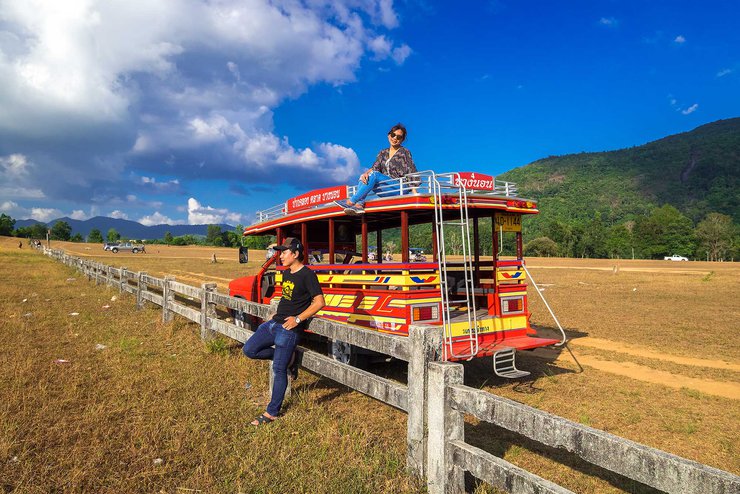
The iconic wooden songthaews, a symbol of Ranong, are a common sight on the city's streets. My sister, the organizer of this trip, arranged for us to travel in one of these charming vehicles. She also meticulously planned our itinerary for the day, as detailed below:
• Breakfast: Delicious roti
• Mangrove Research Center
• Wat Ban Hongaw
• Stop by to buy famous OTOP souvenirs of Ranong.
• Soak in the hot springs.
• Lunch
• Raksa Warin Hot Spring
• Ranong Khen Yon
• Khlong Had Som Paen Reservoir
• Ngao Waterfall
• Grass Mountain
• The Ratnarangsarn Palace
• Dinner
• Walking Street
How is it? My sister's plan is very full, isn't it? Let's see if we can make it to all of them according to the plan. If you're ready, let's get on the wooden bus and travel to Ranong together.

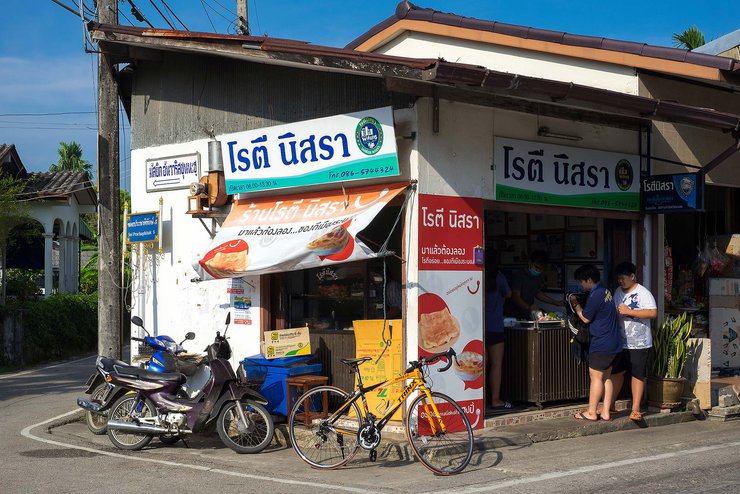
That morning, my wife and I left our accommodation at 8:00 AM. Our first destination, according to the plan, was "Nisa Roti," a roti shop that is said to be very delicious and a specialty of Ranong. We had to try it.
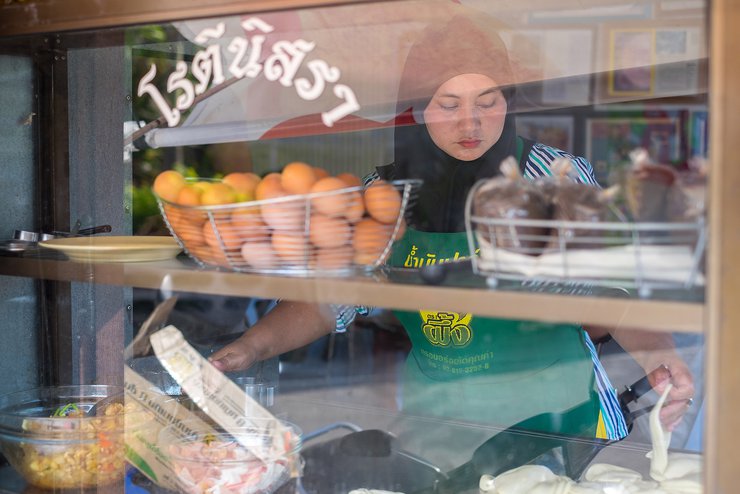
The restaurant has two locations, only a few storefronts apart. The first location, situated on the corner, is a small room with only two tables. The second location, larger and spanning two rooms, offers more seating. My wife and I chose the first location for its charming atmosphere and the opportunity to observe the roti-making process up close.


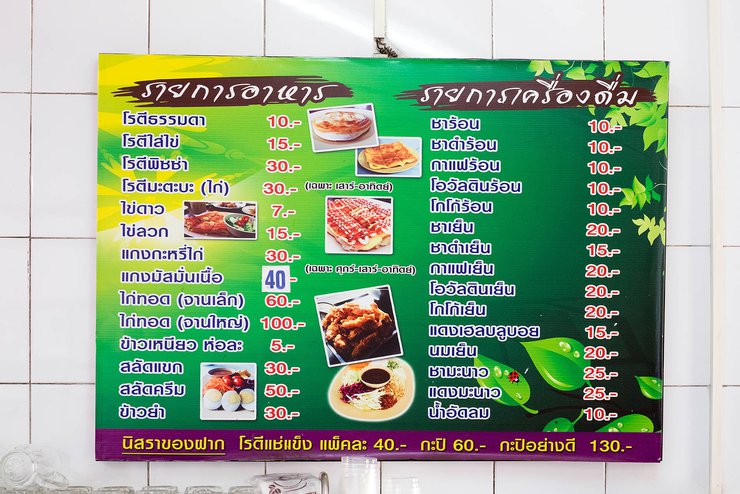
The restaurant's menu is as follows. Ordering is simple: there is an order form on the table. Just write down the items you want and hand it to the staff. Your order will be served shortly. Here are the items I ordered that day:
• Plain roti 3 pieces: 10 baht per piece
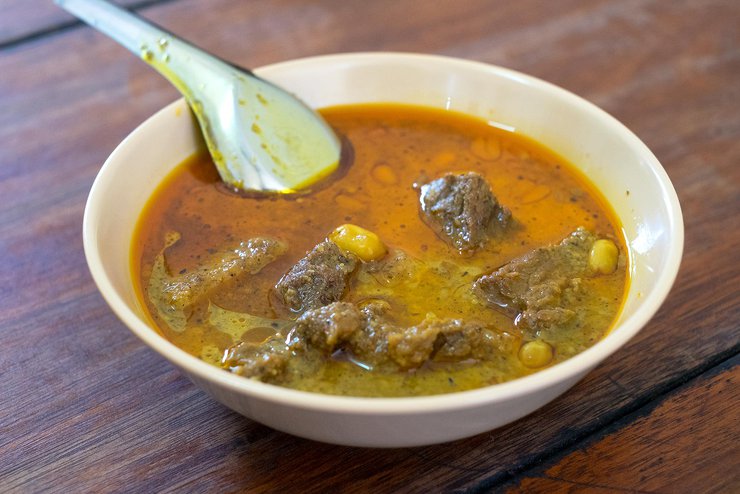
• Beef Massaman Curry: 40 Baht
• Iced tea: 20 baht
• Lime juice: 25 baht

The food we ordered arrived shortly after we sat down. Let's delve into the flavors of each dish one by one.
• Plain roti: Extremely delicious, whether dipped in milk or eaten with curry. The roti dough is perfectly fried, with a crispy exterior and a soft, chewy interior. It's so good that I initially ordered only two pieces, but after trying them, I immediately ordered another piece. I also bought a frozen pack to take home (frozen roti, 40 baht per pack, 8 pieces in total, can be kept outside the refrigerator for more than 10 hours because they are well-frozen).
• Beef Massaman Curry: Delicious and satisfying.
• Iced tea: Very delicious, fragrant, and creamy. Most importantly, it's affordable. This is another menu item that I would definitely order again if I had the chance to visit the restaurant.
• Lime tea: This is ordinary. I recommend ordering iced tea instead.


After leaving Roti Nisra, we headed to the Mangrove Research Center. However, the gate was closed for some unknown reason, leaving us disappointed and unable to enter. @_@ We then took a wooden songthaew to Wat Ban Hongaw, a famous temple in Ranong province. The temple boasts a stunning ordination hall and houses Luang Pho Diiboke, the world's largest pewter Buddha statue.
The temple's ordination hall is incredibly beautiful, and it is situated directly opposite the Hongaew waterfall. However, on the day of my visit, the weather conditions on the Hongaew waterfall side were unfavorable. In addition, the water volume was extremely low, significantly diminishing the waterfall's beauty. As a result, when I took pictures, I could barely see anything.


After paying respects at the temple, I stopped by the Wachi Farm Outlet to buy some souvenirs. It's a large store with a wide variety of OTOP products, especially dried fish, chili pastes, curry pastes, and cashew nuts. Cashew nuts are also known as "ga-yu" in Thai, and they come in a variety of processed forms. Since my wife and I don't cook at home very often, we only bought a small amount. However, if you enjoy cooking at home and have your own transportation, you're sure to find a lot to take home, as they have a wide selection of interesting products.

After purchasing souvenirs, we headed to the Pong Rang Hot Spring to soak in the hot water. To enter, we had to pay an entrance fee to the National Park Authority. The fee for adults is 20 baht per person. This ticket allows you to visit the Hongaw Waterfall, located elsewhere, without paying an additional fee. However, you must visit both locations on the same day.


The Phrang hot springs are naturally occurring hot springs. However, the area where visitors are allowed to bathe is in newly constructed pools. There are a total of five pools. Upon arrival, visitors can walk around and choose the pool they prefer. They can then test the water temperature by touching the surface to see if it is comfortable. If the temperature is acceptable, visitors can change their clothes, shower, and enter the pool.
Note: The five hot spring pools have different water temperatures. The general rules for soaking are to shower thoroughly, wear appropriate clothing, and avoid soaking for more than 15 minutes at a time. There are bathrooms, showers, and changing rooms near the hot spring pools.


In addition to the five hot springs, there is also a natural stream flowing alongside them. Unsurprisingly, most children prefer to play in the stream as it is cooler and there are designated areas sectioned off to create large pools, making it a fun and safe place to swim.


I spent about an hour at the Phrang Hot Spring. Afterwards, I went to have lunch and experience another hot spring in Ranong, the Raksa Warin Hot Spring.
The Raksa Warin Hot Springs, located in the heart of Ranong, are a renowned attraction. The complex boasts three distinct pools: the Father Pool, the Mother Pool, and the Daughter Pool. The Father Pool, with its scorching temperature of 65 degrees Celsius, generates steam and induces immediate perspiration upon approach. In contrast, the Mother and Daughter Pools, situated alongside the road, exhibit a lower water level and a less intense heat compared to the Father Pool.


The Unique Qualities of Raksa Warin Hot Spring
The Raksa Warin Hot Spring boasts a unique distinction as the only hot spring in Thailand containing essential minerals without any sulfur impurities. This allows visitors to directly drink the spring water without any filtration, a rare privilege found in only a handful of hot springs worldwide.
Furthermore, the hot spring water holds cultural significance, being traditionally used in auspicious ceremonies. Consequently, many visitors choose to bottle the water and take it home for personal consumption.
Due to the numerous advantages of the Raksa Warin Hot Spring, the Ranong Province has constructed a hot spring pool near the Father's Pool. This allows individuals to soak in the hot spring to stimulate blood circulation and treat various ailments. The pool is open to the public free of charge.

The Ranong province has constructed a unique health plaza. At first glance, it may appear to be an ordinary concrete plaza. However, upon stepping onto the surface, one realizes the intense heat. This is due to the hot spring water circulating beneath the plaza, heating the ground. The heat is so intense that it is difficult to stand still. Surprisingly, many individuals can lie down comfortably on this plaza. Some even lie directly on the concrete surface without any padding.
The health plaza's primary advantage is its ability to stimulate blood circulation and alleviate knee pain. Consequently, it is unsurprising that a significant number of elderly individuals frequent this location for relaxation.


Beyond the health park, there is a private hot spring area that requires a fee to use. The facilities and privacy are significantly better than the public area. Nearby, there is a charming wooden bridge that allows you to cross to the other side, offering beautiful scenery.


Besides crossing the bridge, you can also walk down to the stream below. I saw many people walking down to take pictures, and some people brought food to eat there. It looked like a refreshing natural atmosphere. Next time I have the chance to come back, I'll try it myself.

After leaving the Raksa Warin Hot Spring, the wooden songthaew took me to Ranong Canyon. The journey took about 30 minutes, as the road was mostly uphill, limiting the vehicle's speed.
Historically, Ranong Canyon was a mine where hydraulic mining was practiced. Water was used to erode the mineral-rich soil from the mountain, which then flowed down and accumulated in a pool at the bottom. Subsequently, the water from the pool was pumped out and the minerals were separated. After the mine closed, it was developed into a tourist attraction, which it remains today.


.
.
This sentence is in English and does not require translation.
.
.
.
The text is a playful request for customers to support young vendors by purchasing their products. The vendors are selling bags for 20 baht each, and the speaker encourages those with more financial resources to buy multiple bags to help the vendors avoid intense competition.


One of the most scenic spots in Ranong Canyon is the viewpoint, which requires a short hike up a hill. The hike takes about 5 minutes, and the view is well worth the effort.
Note: For those who are afraid of getting lost, you can ask the staff who you bought fish food from to guide you. When they guide you back to your car, they will ask you a question that will impress you very much: "Sister, are you thirsty? My shop also sells cold drinks." I must say that this is a great salesperson! Applause!

The next destination after visiting Khao Khanap Nam is Khlong Hat Som Paen Reservoir, which is not far away, about a 10-minute drive. This is an ordinary reservoir, but on a clear day, you can still capture beautiful photos. However, if you don't like hot weather or have limited time, you can skip this spot.


After getting sunburned at Khlong Had Som Paen Reservoir, I continued to Ngao Waterfall. Ngao Waterfall is actually a beautiful waterfall, suitable for viewing from a distance. However, since I had already paid for the park entrance fee in the morning, I decided to take a closer look. This is how I learned that this waterfall is where the Chao Fa crab, a new species of crab with a white body and black claws, was discovered. Due to its unique physical characteristics, the common English name for this crab species is the Panda Crab.
The walk to Haew Narok Waterfall from the parking lot is not far, only about 500 meters. It is a gradual uphill climb. The end of the trail leads to the lower tier of the waterfall. However, when I visited, the water flow was minimal, so I did not take any pictures. If you are short on time, you can skip this waterfall and simply view it from a distance near Wat Ban Haew.
After leaving the Ngow Waterfall, I continued to the Grass Mountain, a small mountain that suddenly appears in the middle of an open field near the main road. This has made the place famous, especially during the time when the grass turns golden in late years.

During my visit to Khao Ya, the sky was exceptionally clear and a vibrant shade of blue. The charming wooden songthaew I rode in added to the picturesque scene, prompting me to take numerous photographs with the vehicle.


After taking photos at Khao Ya, the wooden songthaew took me to my final destination, the Ratnarangsarn Palace. After that, my sister will pick me up for dinner and take me to the walking street.
Ratchawat Ratanarangsan Palace is located at the foot of Ratchawat Ratanarangsan Hill, near the Ranong Provincial Hall. It is a replica palace built to commemorate the visits of three kings to Ranong Province: King Chulalongkorn (Rama V), King Vajiravudh (Rama VI), and King Prajadhipok (Rama VII). The palace is constructed from teak and golden teak wood. Inside the palace, there are several exhibits, including the bedroom of King Chulalongkorn, the Queen's room, the octagonal building, the audience hall, and the bridge connecting the residence building to the octagonal building.
Admission to the palace costs 50 baht for adults and 20 baht for children. Guided tours are available, but only on weekdays (excluding public holidays) between 8:30 AM and 5:30 PM. As I visited on a Saturday, I was unable to enter and could only admire its beauty from the outside.


I spent about 15 minutes walking around the palace before my sister arrived. She then took us to Keang Le Restaurant for delicious seafood and southern Thai cuisine.
We finished our dinner around 7:00 PM. Then we went back to the city to walk around the walking street and enjoy delicious desserts. Finally, I finished the program that night around 9:30 PM. Of course, as soon as I finished showering and my head hit the pillow, I fell asleep soundly and snored loudly. Because it was a very fun day, a day I got to travel to Ranong in a way I never thought I would, a day that made me fall in love with this province. It's a province with real charm, and I think it won't be long before I get to visit this province again.
For those interested in renting a wooden songthaew to explore Ranong like me, try contacting the drivers you see around. The approximate rate is 250 baht per hour, or 1,700 baht for a full-day rental of 8 hours (including fuel and driver). While it might be a bit expensive for a group of 2-3 people, I think it's perfect for a group of 6. It's a fun and relaxing way to get around.
This concludes my one-day trip to Ranong. If you enjoy my travel stories, you can follow me on Facebook at www.facebook.com/amazingcouples for more adventures.
Thank you all for reading to the end. See you again in the next review. Goodbye.



ภรรยาหา สามีใช้
Friday, October 4, 2024 3:23 PM